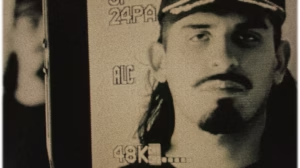
The Japes are a New York City–based band made up of Greg Masters, Isaac Katz, Oliver Katz, and Vincent Katz. The roots of the group stretch back to the late 1970s, when Greg and Vincent first crossed paths in the downtown poetry scene and soon joined singer-songwriter Tom Carey in a band. With Greg on drums and Vincent on keyboards and songwriting, they played at CBGB and other iconic venues of the era.
Decades later, the two longtime collaborators began revisiting Vincent’s songs, rehearsing and arranging them in New York. In 2019, Vincent’s twin sons Isaac and Oliver joined, rounding out the current lineup: Greg Masters (drums), Isaac Katz (lead guitar), Oliver Katz (bass, keyboards, vocals), and Vincent Katz (rhythm guitar, keyboards, lead vocals). That same year, Oliver engineered a session that produced “Above the Rooftops.” Initially set aside as a demo, the track was later remixed by engineer Miles Edwards and officially released on Christmas 2024.
Today, The Japes remain focused on studio work, with four new recordings currently being mixed — a continuation of their evolving collaboration across generations.
How did the original connection between Greg and Vincent form, and how has that early experience shaped The Japes’ sound today?
Vincent: It was 1978, or maybe late 1977, and I was contacted through the NYC East Village poetry world grapevine. Someone named Tom Carey had a band that had fallen apart. He had taken his drummer, Greg Masters, and fled the flames. He’d heard I was a keyboard player and songwriter. Would I be interested in joining them? Tom had some good songs, including one called “Small Strokes” and another called “The Sewer Line.” They were catchy, and I helped Tom re-arrange them. We also collaborated on “Further Proof” (Tom’s lyrics, my music) and “Mr. Wonderful” (same deal). I loved Greg’s drumming! We had fun playing several gigs around town, most notably at CBGB.
Greg: Vincent and I knew each other from the downtown poetry world, largely centered at The Poetry Project at St. Mark’s Church. We were in a band together in the late 70s. Vincent was still in high school and I was 20 or so. We played a few gigs at CBGB and perhaps some other venues. But playing at CBGB was a big deal. It was the big time in our niche of downtown culture. We both were poets, an even smaller niche than downtown rock n roll. We witnessed the growing appeal and popularity of bands we felt had similar rebel energy distilled from Beat literature, particularly Allen Ginsberg’s Howl and Jack Kerouac’s On the Road. And we wanted to broaden our audience beyond the 30 or so folks who’d show up at our poetry readings. Our band sound wasn’t aggressive, screaming punk. Rather, it was more an extension of the ensemble sound of The Beach Boys and The Beatles. We were performing songs written by our frontman Tom Carey, a poet who branched out into writing songs, such as “The Pills Aren’t Working.”
What inspired you to bring Vincent’s twin sons, Isaac and Oliver, into the band and how has that family dynamic influenced your music?
Vincent: After some years had passed, and both Greg and I had bounced around different bands and situations, I suggested he and I start jamming in my basement studio. We did, and it was fun. Greg wanted to invite other musicians to join us. I liked the idea in theory but wanted to find the right folks, people who would blend in psychologically as well as musically. In a sense, I was bringing up Isaac and Oliver to fill those roles. I gave them their first CD, knowing it would play a formative role: Sgt. Pepper’s Lonely Hearts Club Band. The next after that was The Boredoms, whose song “Acid Police” became a favorite. Then large doses of The Clash sealed the deal. Flash forward, Isaac and Oliver have done a lot of music, played in bands, and are back in NYC. We invite them down, and the sound fits.
Greg: For decades Vincent and I would play his songs in a basement studio and the young Isaac and Oliver were welcome to hang out and shake maracas. After they graduated college and were back in New York City, they had developed into fine musicians and engineers. They sat in with us. Vincent and I both noticed how well they fit in and how their contributions fattened up our sound. It was so easy. The music improved immeasurably. They knew exactly what to layer in. And we rehearsed regularly for three years and worked hard to achieve a tight, rich sound before we called in recording engineer Miles Edwards to record the band. For me, to see the two sons work closely with their dad so cooperatively is a delight. We each push each other to play better.
Can you talk about the creative process behind your single “Above the Rooftops” and what it means to you as a band?
Vincent: “Above the Rooftops” was written with my early songwriting partner, John Assadi. He wrote the lyrics, and I wrote the music. In fact, all the songs on our upcoming EP were written in earlier eras. I have a lot of songs I like that were never put out properly, or at all. I love having this opportunity to record them and get them to sound the way they should. The lyrics of “Above the Rooftops” always inspire me. They evoke a vision of New York City, or any city really, that is connected emotionally to personal relationships. A lot of John’s lyrics have that emotional connection. It has something of an “Up on the Roof” feel, mixed with early skiffle beat, but totally contemporary at the same time. It means a lot to me personally.
How did the collaboration with engineer Miles Edwards come about, and what impact did his remix have on the final release?
Vincent: Through Oliver, we met Miles, along with other musician-engineers who now are part of the team at our recording studio, Laurel Road Studios, in Chelsea, Manhattan. We recorded “Above the Rooftops” in 2019 with Oliver doing the engineering. We liked it but didn’t feel it qualified for release. Instead, we thought of it as a demo, and we always wanted to re-record it. In 2024, we decided to record some songs, and “Above the Rooftops” was on the list. First, though, we showed it to Miles. To this day, I don’t know exactly what he did. You could interview Miles for more detail! But when he played it for us, we all looked at each other and said, “This is it! It sounds perfect.” That’s the genius of a brilliant engineer — like an editor with words, the engineer can take a messy mass of sounds and see what to accentuate, what to subdue, when to add delay or reverb, or other effects, and produce music out of it.
Greg: Miles is an indispensable extension of our band. Once he came on board to record and mix us, we were able to compare different takes of tracks. We are essentially a studio band. We laid down the basic sound in the studio, the four of us playing together live. Then, we layered multiple tracks on top to achieve a broad sound. Miles was so patient when we’d want to try further takes and try adding an organ or tambourine or redo a part. His expertise and guidance were greatly assuring. We were satisfied, knew we had something, when he said we did.
What are some of the biggest challenges and rewards of working together as a multi-generational band?
Vincent: The biggest challenges we have are around scheduling. Oliver and Isaac have lots of projects and obligations. Greg and I tend to travel quite a bit. The rewards are when we get together in the studio. Playing together is always relaxing and joyful. We all share a work ethic which comes to the fore in rehearsing numbers and working on arrangements.
Greg: I suppose the press might latch onto that aspect of the band’s makeup. But for me it’s just four musicians working together. At this point we’ve recorded an EP’s worth of Vincent’s compositions. I look forward to working on tunes by Oliver and Isaac.
How do you balance your focus between live performances and studio work?
Vincent: So far, we are focused solely recording in the studio. We are working to get some of our songs down as we would like them to sound. That said, our process involves playing together as a band, and we all have experience playing live, so that would be possible; it’s just that we just are focusing our energies for the time being on recording.
Greg: We’ve been discussing whether to do any live gigs. I know it would help increase our visibility but I’m not certain we’re going to be able to tour, given that we’re each involved with so many other projects.
How would you describe the evolution of your music style from the early days playing downtown NYC venues like CBGB to your current sound?
Vincent: Our early style, with the band sometimes called the Tom Carey Vincent Katz Band, sometimes Tom Carey & The Eskimos, was coming out of The Beatles, with maybe some reggae, funk and new wave elements. My later band, in the early 1980s (we also played CBGB) focused on song-writing, bringing together further influences, including The Velvet Underground, punk, and country and western. Still later, in the late ‘80s, I had another band (also played CBs) that added experimental elements, recorded sounds, occasional saxophone, more complex harmonic changes and rhythms. From there, I abandoned the band format and worked with one other musician on house and techno-influenced music, expanding that eventually with a DJ, sax and trombone, and dance, performance and projected images. We performed in dance clubs in New York like the Roxy. In the early 1990s, I composed an Acid Rap Opera, a full theater production with songs that ranged from Sixties-sounding tunes to house anthems to quirky raps. What we are doing now relates to some of the music we were doing in the early ‘80s but developed in collaboration with Isaac and Oliver, who, while they are steeped in the music Greg and I have loved, also bring other influences plus their own interpretations of how parts should interact and fit together.
Greg: We’ve certainly evolved from a basic three-chord assault steered by hormones to rouse an audience to a more nuanced art product focused on expressing observances and reflections hopefully to be shared with a big segment of the populace.
Can you share any stories or memories from your early days playing the downtown NYC music scene?
Vincent: I remember playing in loft parties with notorious downtown figures like poets Jim Brodey and Rene Ricard in the crowd, and playing at the Poetry Project, where Brodey said he liked my keyboard playing. CBs was considered the highest platform at the beginning. The people who worked there were a little oblique and didn’t always understand what we were doing. Later, I enjoyed playing clubs like Lizmar Lounge, where poet John Godfrey and painter Martha Diamond came to see us, and Downtown Beirut, where we were able to bring in our techno experimentation to its fullest fruition. I also performed at The Limelight, which was a great show, a whole other level of sound system and lights. We brought our projections, and it was a big show. I had to go back later with our keyboard player, Mercury (AKA Marc Barrow), to collect our take. We asked around the labyrinthine back hallways of the club, finally finding the man and getting paid.
Greg: Sharing music and poetry with friends was always the point, to receive validation that we all were plugged into similar essential sources and were finding bonds with others whose tastes coordinated. Logistically, it was a task. None of the bands I played with ever had a van, so getting to gigs for me involved shlepping my drums up and down five flights of stairs and into and out of cabs. But, we were young and full of energy and aspirations and drive. It was all worth it. And fun. If I recall correctly, Vincent and I backed Tom Carey on a bill with Richard Hell and the Voidoids, a benefit for The Poetry Project at CBGB. Elvis Costello popped up on stage to sing harmony on two of Richard’s songs. Getting paid was hardly a consideration when you’re in rock n roll Valhalla.
What themes or emotions do you find yourselves exploring in your latest recordings?
Vincent: So far we have recorded older songs that have the emotions of being young and experiencing things for the first time. It has been interesting to interpret them via an intergenerational band. We will continue to record some of our earlier songs, but we also want to branch out into writing from different perspectives. Interestingly, a lot of the themes we wrote about when young still feel relevant. “Above the Rooftops” is a poetic take on floating above the city, feeling its energy and romantic possibilities but somehow remaining aloof. “I Remember Hugo” recalls the specifics of a location (Cambridge, Mass.) and the feelings two people (friends, not lovers) can share in the excitement of an evening. “Ballad of a Don” is a verbal trick, subtly comparing two types, one more conventional, the other blossoming into his realness via rock and roll. “Pop Your Pimples, Brat” started as a punk parody then took on a life of its own. Rock must be sung and performed with complete commitment, otherwise it falters and fails. It’s kind of a punk surf-rock tune. “You’ve Extended Me” is a fast-paced and clear-eyed look at the difficulties of maintaining a relationship.
What’s next for The Japes in terms of releases, tours, or other projects?
Vincent: We already have a number of songs written that we want to record, and we want to write new ones as well. For now, our projects are keyed to the recording studio, trying to discover our sound via the recording process.
Greg: Essentially, we’d just like it if people heard our EP. Anything else consequent to that, we’ll see.
Discover more from Indie Music Discovery
Subscribe to get the latest posts sent to your email.