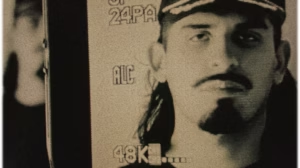
In an era when albums often appear and disappear within the same news cycle, Will Dailey’s seventh record, BOYS TALKING, arrives carrying something almost unfamiliar: patience. Released today on streaming platforms after an intentionally long physical-only window, the album is the culmination of a creative and philosophical experiment that places human connection over algorithmic momentum.
For eighteen months, BOYS TALKING existed outside the dominant machinery of modern music consumption. No playlists. No digital campaigns. No urgency-driven marketing. Instead, Dailey chose a slower, more tactile route, offering the album only on vinyl, CD, and direct download. The songs traveled through live rooms, long drives, conversations, and intimate performances, building meaning gradually rather than chasing reach.
This decision feels particularly bold given the pressures of today’s music economy. Artists are often encouraged to feed the system continuously: frequent singles, short-form clips, constant content. Dailey stepped away from that cycle, trusting the material—and his audience—to carry the record forward organically. The result is a release that feels less like a drop and more like an arrival.
BOYS TALKING itself is a deeply human record, built from ten songs selected from nearly eighty demos and sketches. The process of subtraction helped clarify the album’s emotional center: men trying to communicate. The record explores the fragility, awkwardness, restraint, and yearning that live inside those attempts, without framing them as heroic or tragic. Instead, the songs allow uncertainty to remain unresolved, presenting emotional honesty without tidy conclusions.
Musically, Dailey’s songwriting pulls from a broad American lineage—folk, soul, rock, funk, and pop—while remaining deeply personal. Tracks like “Send Some Energy” and “Tremble On Me” move through grief with a hushed intimacy, while “One at a Time” snaps forward with restless urgency. “Make Another Me,” featuring Juliana Hatfield, reflects on isolation in an increasingly synthetic world, and “My Own Ride,” featuring Danny Clinch, leans into memory and emotional inheritance.
Recorded live over ten days with an ensemble of collaborators gathered in one room, the album preserves the friction and warmth that emerge when musicians interact in real time. Minimal overdubs allow small imperfections to remain, reinforcing the album’s central themes of vulnerability and sincerity.
Dailey’s career has long unfolded along this quieter path. Boston-born and fiercely independent, he has cultivated a reputation as an artist’s artist—respected by peers, admired by collaborators, and deeply trusted by audiences. Over time, he has shared stages with figures like Eddie Vedder, Peter Buck, and Jakob Dylan, yet he remains outside traditional commercial narratives. That position has afforded him freedom: to take risks, to resist formulas, and to build work that unfolds on its own terms.
The release of BOYS TALKING on streaming platforms today is not a pivot toward mainstream rollout, but a continuation of its journey. One track remains exclusive to physical formats, honoring those who engaged with the album slowly and deliberately. It’s a small but meaningful gesture, underscoring the idea that access and availability need not always be instantaneous.
Ultimately, BOYS TALKING stands as both an album and a quiet protest against speed culture. It invites listeners to linger, to listen closely, and to remain present. In doing so, Will Dailey offers something rare: music that unfolds like conversation, not consumption.
Discover more from Indie Music Discovery
Subscribe to get the latest posts sent to your email.