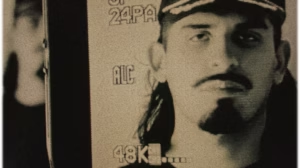
If you enjoy energetic, soulful, acoustic-driven alt-rock, Ben Aubergine delivers exactly a new single you should consider adding to your playlist. Spoke For What I Knew is now streaming!
In this interview spotlight, I chat with Ben about the single, his “return” to music, dream collabs, and much more. This is one of the best interviews we’ve published in a while so sit back, click play, and enjoy learning about Ben Aubergine and Spoke For What I Knew.
Full Q&A along with links and music below.
In our initial chat you mentioned you’re returning to music. Can you provide context for our readers on what/where you’re returning from? Many of us can relate to your journey.
Yeah, when I say I’m “returning” to music, I don’t mean I ever really stopped playing. But I’m coming back to a part of myself that was defined by it. As a teenager, music wasn’t just something I did. It was who I was. I got my first guitar when I was eight. At first I just made noise, but eventually I figured out how to play a bit of the “Patience” solo by Guns N’ Roses. That was enough to convince my parents I was serious, and they got me a teacher. From there, music became an identity.
I was in bands all through middle and high school. The first was called Plastic Amigo. We were trying to be a cross between Led Zeppelin and Smashing Pumpkins, and when you have 13-year-olds trying to mimic that with a very rudimentary understanding of songwriting and musicianship, it ends up sounding pretty generic. But we were advanced for our age, and the experience was a spark for my young brain. Later came Punk Monkey, which was more focused. I went from being a guitarist to the singer, primary composer, and lead guitarist of the band. That was a big step up for me in focus and songwriting. But like a lot of high school bands, we broke up before graduation.
Then in college, I discovered I had a real aptitude for math and science, which took me down a very different path. I never stopped writing songs. I played coffee shops, bars, and an occasional local festival. But music became more of a private thing than something I imagined as a future. That’s a moment I think a lot of musicians hit—the rock star dream meets real life.
In my case, real life became medicine. I got into med school, then residency in emergency medicine. I got married, moved to the suburbs, we had a daughter. Life was unfolding in the way that it tends to after your twenties. What’s funny is, if I’d stayed in music, I probably wouldn’t have been able to afford any of the gear I wanted. But now, as a mid-career ER doc, I finally have the time and the tools to record the music the way I always wanted to. I’ve got a home studio, the instruments I used to dream about, and the time and space to explore music I left unfinished.
So lately, I’ve been digging through songs I wrote in my teens and twenties. Things I never properly recorded or finished. I’m finally giving them the attention they’ve been waiting for. New music will come, I know that. But right now, it’s about completing what I started years ago. So yeah, it’s a return to music, but also a return to a version of myself I never really let go of.
What is the story behind Spoke For What I Knew? Any notable themes or inspirations?
“Spoke For What I Knew” was written back in 1998, and it came out of a very real moment in my life. I don’t want to give away specifics that might identify anyone, especially since it’s been over 25 years and the person involved may not even realize they were part of this story.
It was New Year’s Eve, 1997, and I was at a house party with someone I’d known through high school. There had always been some kind of connection between us, or at least that’s how it felt to me at the time, and that night I decided to tell her how I felt. I pulled her aside and laid it all out. She didn’t feel the same, and I didn’t take the hint. I kept trying to explain myself, to clarify what I meant, to get her to engage when she clearly wanted space. She tried to avoid me, and I kept pursuing her throughout this chaotic house party. The tension of the moment irreparably damaged whatever connection might have been there, or might have grown into something. And in the end, the only way forward was to separate. We never really interacted again.
When I wrote the song, it was very much about that night and that person. But listening to it now at 45, I hear something bigger than I understood at 19. It’s about how fragile human connection can be. How two people can be close to something meaningful, but the moment you try to force it into a new shape, it breaks. Unfortunately, sometimes the only resolution is to let it fall apart and stop trying to salvage something that can’t hold.
That’s what the song is about. Not just that one event, but the very human experience of emotional asymmetry. Misaligned timing. The experience of speaking your truth and watching it land in a way you didn’t expect. And how sometimes that kind of rupture can’t be repaired.
A side note that makes me laugh now: when my mother-in-law first heard the finished track, she got really worried. She didn’t know the backstory and thought maybe it was about something current. Just to be clear for everyone who knows me, this is a song from 25 years ago. My wife is incredible and we have a great relationship. Nobody needs to worry. It’s just an old story I finally finished telling.
What is your earliest music memory? Or a moment that sticks out for motivating you to write, record, and release music?
My earliest music memory goes back to when I was maybe eight or nine. My parents had bought me this old acoustic guitar, and I was obsessed with trying to learn the opening notes of the solo from “Patience” by Guns N’ Roses. I didn’t know how to play—I was just picking out notes on the high E string with one finger, and it sounded awful. But I was proud of it.
Then one day my cousin Gary came over for a family holiday. He saw the guitar sitting in the corner and asked if he could play it. He picked it up and started into a simple 12-bar blues. Nothing flashy, just clean chords and maybe a little lick or two, but it was actual music. I had spent months listening to my own clumsy noise, and suddenly this instrument was doing what it was supposed to do. That was the first time I heard a guitar played well in person, and it completely blew me away. I remember thinking, “I have to learn how to do that.” That moment locked something in. It was the first time I really understood the emotional power an instrument could have in the hands of someone who knew how to use it.
Then there’s a second memory that broke open my understanding of recording as a whole new way of experiencing music and sound. Back in the early ’90s, I used to pore over the Musician’s Friend print catalog. I’d spend hours reading about every piece of gear, over and over. Eventually I convinced my parents to buy me a Tascam 4-track cassette recorder. I had no idea what I was doing, but I figured out how to lay down chords on track one, then overdub a solo—an objectively terrible solo—on track two.
But hearing those two layers play back together for the first time was transformative. It hit me that I could have multiple instruments playing together, even though I was just one person who could only play one instrument at a time. I realized that recording and arranging were their own creative outlets, independent of the music itself. Since then, I’ve been drawn not just to writing songs, but to shaping them, capturing them, sculpting the sound into something lasting. That combination, the emotional spark of live performance and the intention of studio work, is what’s kept me engaged with music all these years.
What keeps you going, especially on “bad” days?
Honestly, I’m lucky in that I don’t have a lot of bad days, at least not in the way some people do. But when it comes to music, a “bad day” usually means I’m feeling stuck. Sometimes it’s that everything I’m playing or writing feels like a variation on something I’ve already done, or worse, something someone else has already done. There have definitely been times when I’ve been deep into a new idea and suddenly realized, “Wait… I think I just rewrote Every Breath You Take.” Then comes the awkward choice: do I change it, scrap it, or just own it?
But a bad day musically is when nothing feels original. When I pick up a guitar or sit at the piano and every chord progression feels like it’s been looping through my hands for the last 30 years. That’s when self-doubt creeps in, the feeling that maybe I’ve hit a ceiling, or said everything I have to say.
The upside is, I don’t rely on music for income. I’m not on a deadline, there’s no label, no pressure to release on a schedule. So when that feeling hits, I can stop. I can walk away from it. Unfortunately, sometimes when you step away, there’s a risk that you might step away for 25 years. But eventually I come back, and when I do, things usually feel fresh again. That kind of creative breathing room is a real luxury, and I don’t take it for granted.
I think about how the Beatles made their most ambitious music after they stopped touring and were able to live in the studio on their own terms. That mindset resonates with me. If you try to force something creative, it rarely works. Sometimes the best way forward is to pause. And for me, that pause always leads back to something worthwhile. The spark returns. It always does.
If you could collaborate with anyone – dead or alive, famous or unknown – who would it be and why?
This might sound like an unexpected answer, especially since the influence isn’t always front and center in my recordings, but if I could collaborate with anyone, dead or alive, it would be Ben Folds.
Ben Folds Five had a huge impact on me when I was a teenager. I still believe some of his best work came from that band. The way he combined piano-rock grit with sharp songwriting and clever, emotional storytelling left a mark that’s never really faded. Even in his solo work, which is more refined and less chaotic, the craftsmanship is incredible. He has a rare grasp of melody, harmony, phrasing, and structure. He writes songs that move, both emotionally and musically.
Of course, there are megastars I’d love to meet, talk with, maybe even play with—Buddy Holly, Nick Drake, Freddie Mercury, Izzy Stradlin from Guns N’ Roses. It would even be kind of wild to sit down for a listening session with early Romantic composers like Chopin or Rachmaninoff and ask them what they think about jazz and punk. But if I’m thinking about someone I’d actually want to sit down and write with, it’s Ben.
He hears things that I think most musicians miss. He knows how to throw in an unexpected chord, a strange modulation, or a rhythmic twist that somehow feels completely natural. Listening to him taught me how to bring jazz harmony into rock songs without losing the edge. I can look back at songs I wrote in my teens and twenties and trace the influence. It might not be obvious, but I know it’s there. Certain chords, textures, bass lines… that’s him, showing up in the margins of my songs.
And funny side note—when my wife and I were planning our wedding, we were looking for a band, and I decided to throw a Hail Mary and reached out to Ben’s management to ask what it would cost to book him for the night. To my surprise, they actually responded. They laid out everything: his travel requirements, gear needs, and the exact language that would need to be used in any press or promotional materials. It was a full professional breakdown. We ended up with a great band, just not Ben Folds. But I still think about that email sometimes. I mean who knows, maybe if I had booked him back then, he’d be open to collaborating with me now.
What makes a great song; to you, at least?
What makes a great song, at least for me, is when it leads you away from where it starts, takes you somewhere unexpected, and then brings you back. There needs to be a familiar home at the beginning—something that makes the listener feel grounded. And then you leave it and introduce tension. From there, you have choices. You can keep going, farther from where you began. You can return home. Or you can stay lost in the wilderness until the end of the song, where I guess you just stay forever.
It’s not so different from the structure of a story. Think about The Lord of the Rings: the characters start in a peaceful place, they’re pulled into chaos, everything changes, and then they return. They’ve gone through something dramatic and powerful, and they come back changed, but whole. I think the best songs mirror that arc, even in a compressed three- or four-minute format.
What makes music especially expressive is that we get to tell that story not just with words, but with sound—texture, timbre, harmony. You don’t have to say something is sad. You can make someone feel it in the tone of an instrument or the tension in a chord progression. That’s where songwriting starts to feel cinematic to me.
So I tend to gravitate toward songs that create surprise. Songs that take me somewhere I didn’t expect, harmonically or emotionally. Classical composers are masters at this—modulating between keys, weaving through different modes and tonal centers, and then somehow returning home. Pink Floyd and Stevie Wonder are also excellent at it. Their songs often drift into strange, atmospheric territory, but when they come back, it feels warm and relieving, like you’ve made it back to a safe place after a long journey.
And not all songs return. Some leave you in the unknown. That can be effective too, especially when the goal is to leave you with discomfort or ambiguity. Radiohead is the best example I can think of for this. But the ones that stay with me the longest—the ones I’d call great—are the ones that take you somewhere unexpected and then bring you back again.
I know it’s hard…but favorite song (or artist) of all time? Or Top 3?
People often ask what my music sounds like, and I always find that question hard to answer. I think “indie rock” or “alt-rock” gets you in the ballpark, but honestly, that leaves you with a range from Gotye to Soundgarden, which is a pretty vast stretch of musical territory. The best way to describe it might be to name my top three—or maybe four—favorite artists. Because if you blended them together, you’d land somewhere close to what I do.
At the top of that list is The Beatles. Even if the recordings sound dated to some listeners today, the musical ideas are still completely relevant. In the early ’60s, the idea of a fully realized pop song was still evolving, and The Beatles more or less invented the blueprint. Hooks, choruses, orchestration, harmonic layering—so much of what we now take for granted in songwriting traces back to what they were doing. I’ve always been more drawn to Lennon’s darker, grittier style than to McCartney’s polished melodic sensibility. But between them, they perfected the art of the pop song. A lot of modern music still leans on ideas they introduced more than half a century ago.
Now take that Beatles DNA and crank up the distortion and the emotional edge, and you get Nirvana. I was twelve when Nevermind came out, and that album hit me like a tidal wave. It still does. It’s not just Kurt Cobain’s raw songwriting and vocal style, though that’s central. It’s also Dave Grohl’s drumming, and later his songwriting with Foo Fighters. The Foos are who taught me to care about percussion as a compositional tool. I didn’t grow up already drawn to it—it was Nirvana and Grohl that shaped that instinct in me. Dave Grohl writes music like a drummer, and it completely changed how I think about rhythm, structure, and dynamics. John Bonham played drums in a way that blended them with the structure of the song, so the whole thing felt like one cohesive, melodic, percussive statement. Dave took that idea and pushed it even further.
Third would be Pink Floyd, starting with Dark Side of the Moon. That’s where I think their true voice begins. Floyd taught me to think about the soundscape—even in rock music. They showed how a song could breathe, evolve, and stretch without losing emotional grip. David Gilmour can tell an entire story in a single solo. Rick Wright’s keyboards were the subtle glue that held the band together. It’s proof that you don’t have to be Enya to justify having synth pads in your mix. Across their albums, even across their full catalog, they were telling one long story about humanity. And they didn’t need to say it directly. Their use of harmony, space, and pacing gave everything shape.
If I get to sneak in a fourth, it’s Richard Thompson. He’s criminally underrated. His guitar playing is completely his own – percussive, melodic, unpredictable. But his songwriting is what’s truly underappreciated. He uses modal shifts, twisted melodies, and unexpected lyrics to take you to places that feel ancient and new at the same time. His influence on how I write solos and transition through chord progressions is huge, even if it’s not always front and center.
So if you take the harmonic sophistication and hooks of The Beatles, the grit and rhythm-driven force of Nirvana and Grohl, the emotional depth and sonic architecture of Pink Floyd, and the modal inventiveness and soloing of Richard Thompson—that’s the music I want to listen to. And not surprisingly, it’s the music I try to make.
Where’s the best place to connect with You?
If you’re looking to connect—to talk about music, songwriting, or the creative process—the best way is email. I’d genuinely love to hear from people who are interested in that kind of dialogue. You can reach me directly at admin@benaubergemusic.com.
As for the music itself, it’s on all the usual platforms—Spotify, Apple Music, YouTube, wherever you listen. I’m also doing my best to keep a presence on social media. It’s definitely a learned skill for me. I didn’t grow up posting every thought online, so I’m figuring it out as I go. But I see the value in it—sharing new releases, reviews, behind-the-scenes moments. I’m also planning to post more personal content—like live performances or stripped-down acoustic videos, kind of like how I used to play in my twenties.
So yeah, email if you want to talk, streaming if you want to listen, and social media if you want to follow along while I figure out how to do this part of it in public.
I appreciate Your time. Any last thoughts before signing off?
First, I just want to say thank you—both for taking the time to listen to my music and for extending this interview to me. It means a lot, especially for someone like me who’s flying far under the radar. Most new indie musicians go completely unnoticed, so I’m grateful for the chance to let people hear the song and maybe learn a little bit about where it’s coming from.
And just to be clear, I’m not treating this like a debut. This isn’t a career change for me, and I’m not under any illusion that I’m launching some new chapter in the music industry. If you decide to build a recording studio, write, arrange, track, mix, distribute, and promote at this point in your life, it’s not because you think you’re going to become a star. I mean, that might happen. But at this stage, it’s probably not your motivation. You do it because you love it. Because these sounds live somewhere inside of you, and they have to come out. It’s an unsettling feeling to not release them into the world.
Sometimes I wonder, if a song gets written and never recorded, does it even really exist? If it only lives in your head, or on paper, or even in other people’s heads, what form does it have? Is it really a song, or just a thought that can be forgotten? How many masterpieces started in someone’s head, maybe even made it as far as a piano and vocal performance, but were never recorded, never preserved, and the world never got to hear them?
For me, music isn’t fully realized until it’s recorded. The music I wrote almost 30 years ago is almost fully developed and arranged, but it’s still only in my head, or maybe on a few grainy demo cassettes or CDs somewhere in storage. So I have to record these songs. I hope people listen. But even if no one listens, the songs will definitively exist. In 200 years, Spoke For What I Knew will still be sitting on a server somewhere—hopefully searchable and streamable, but more than likely untouched for decades and centuries. But it will certainly exist.
There are still eight or ten songs that I wrote decades ago that I’m now in the process of finishing and recording. And I also have songs that exist only as loose ideas—fragments in notebooks, melodies in voice memos on my phone, half-formed lyrics and chords. My focus right now is to finish all of them. And then there will be new songs. And I guess you just keep doing this, forever, until you have no more songs left inside of you.

Discover more from Indie Music Discovery
Subscribe to get the latest posts sent to your email.