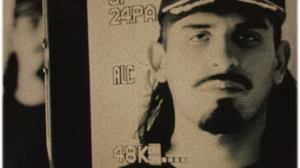
For more than a decade, Danielle Alma Ravitzki has been a quiet force in the Israeli music world—an artist celebrated for her literary sensibility and emotional fearlessness. Now, under her new alias Mifarma, the New York-based singer-songwriter steps fully into the international spotlight with Mifarma, an arresting and beautifully realized debut in English that redefines her artistic identity.
From its opening notes, Mifarma feels like a reclamation—a slow and deliberate unfurling of truth. The album’s first single, “I Left the Room Without My Hair,” serves as both a statement of intent and a meditation on transformation. Co-written with her longtime mentor Shara Nova, the track is an unflinching portrait of loss and renewal, balancing sparse production with ghostly vocal layering that seems to hover between exhaustion and transcendence. There’s a tactile quality to the song, as if Mifarma has managed to turn emotional unraveling into sound.
Mifarma’s evolution as an artist has been marked by an ever-deepening intimacy. Her early work in Hebrew paired the words of poets with lush, classically influenced arrangements, but Mifarma marks the point where her writing becomes entirely her own. Gone are the walls of metaphor and myth; in their place is unvarnished self-revelation. She writes and sings like someone who has been stripped to her core and decided that the only honest response is to keep going.
Across its eight tracks, Mifarma becomes something like an emotional travelogue. Each song traces the contours of a life in flux, a body trying to reconcile pain and purpose. “Fix Me Up” aches with quiet determination, all soft synths and aching vocal harmonies, while “Five Stages of Grief” takes the listener through the circular, maddening rhythms of loss. In “I Am Soil,” Mifarma finds beauty in decay, her voice fragile but resolute as it rises against minimalist piano and percussion.
The production—helmed by two-time Grammy nominee Carmen Rizzo—mirrors this tension between fragility and fortitude. Rizzo’s fingerprints are subtle yet unmistakable: muted beats, cinematic swells, and wide sonic spaces that allow Mifarma’s voice to anchor the listener. It’s the kind of collaboration that feels destined, a perfect alignment of vision and sensibility. The story behind it—an accidental rediscovery of a Berlin record featuring drummer Earl Harvin that led her to Rizzo—is the kind of serendipity that seems to define the album’s spirit.
Supporting performances from Nova, Harvin, Melissa Lingo, and Piers Faccini lend the record a global resonance. Nova’s spectral harmonies deepen the emotional undercurrents, while Faccini’s textural guitar work adds warmth to the more experimental compositions. Yet even amid these collaborations, Mifarma’s voice remains the gravitational center. Her phrasing is meticulous but raw, capable of sounding both world-weary and newly reborn in the same breath.
Stylistically, Mifarma defies easy classification. It’s art-pop by way of ambient folk; it’s chamber music that’s wandered into the realm of electronica. The eclecticism feels organic, reflecting Mifarma’s transnational identity and her fascination with sound as a universal language.
Visually and conceptually, Mifarma seems to exist in perpetual motion. Her social media offers glimpses of a life lived in transit—snippets from Paris rooftops, Delhi streets, and anonymous train stations. That restlessness finds its mirror in the music: the sense of belonging everywhere and nowhere, of being both observer and participant. When she sings, it’s as if she’s narrating her own migration through grief, recovery, and creation.
Even as Mifarma confronts heavy subjects—trauma, loss, identity—it refuses to succumb to despair. Instead, the album is guided by a quiet, persistent hope: that through acknowledgment comes healing, and through exposure comes strength. Tracks like “Somnambulist” and “Rejection is My Pendant” illustrate this balance perfectly, shifting between moments of dreamlike introspection and fierce self-assertion.
In the end, Mifarma is less a debut than a renewal—a rebirth of an artist who has learned to translate pain into poetry without losing her sense of wonder. It’s an album that rewards patience and presence, revealing new emotional textures with each listen. For those encountering Danielle Alma Ravitzki for the first time, Mifarma is a mesmerizing introduction. For those who have followed her journey, it’s a breathtaking continuation—an act of transformation rendered in sound.
With Mifarma, she doesn’t just invite listeners into her world—she builds one around them, fragile and fierce, devastating and alive.
Discover more from Indie Music Discovery
Subscribe to get the latest posts sent to your email.